
About Cataracts
A cataract is a condition in which the eye’s natural lens becomes cloudy.
It is commonly seen in people over the age of 40 and can affect visual acuity.
When the lens becomes cloudy, objects may appear blurred or hazy, vision may become double, or light may feel excessively bright.
As the condition progresses, eyesight gradually declines.
The main cause of cataracts is aging — this type is called age-related cataract.
In some people, it can begin as early as their 40s, and by their 80s, many individuals develop some degree of cataract.
Other causes include eye injury, other eye diseases, or congenital factors present from birth.

Treatment for Cataracts
In the early stages, medication may help slow the progression of cataracts, but it cannot completely cure the condition.
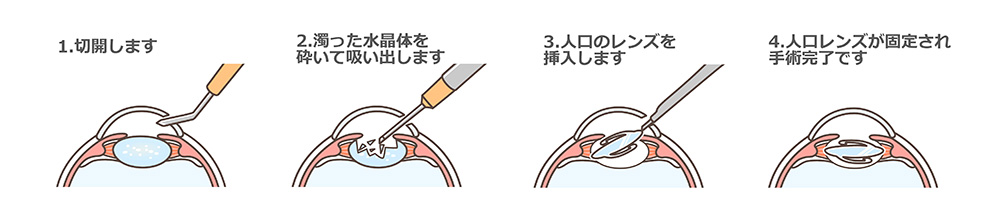
When the cataract advances, surgery is performed to remove the cloudy lens and replace it with an artificial intraocular lens (IOL).
The procedure is performed under local anesthesia, so there is no pain, and patients can hear the doctor’s voice and even communicate during the surgery.
Although the exact time varies depending on the case, surgery usually takes about 30 minutes.
The most common surgical method today is called phacoemulsification, in which the cloudy lens is broken up and removed using ultrasound through a small incision of about 3 mm.
An intraocular lens is then implanted into the remaining thin capsule.
This artificial lens restores vision — without it, patients would experience significant farsightedness and blurred vision after surgery.
There are several types of intraocular lenses.
Some absorb ultraviolet (UV) light, others have a slight tint like sunglasses, and some are multifocal lenses that allow both near and distance vision.
In most cases, monofocal lenses are used, and our clinic generally recommends monofocal IOLs for standard cataract surgery.
Before Surgery
Once your cataract surgery has been scheduled, several detailed examinations will be performed to evaluate the condition of your eyes.
If there are underlying diseases of the retina or optic nerve, vision may not fully recover even after a successful surgery.
Before the operation, it is also necessary to determine the refractive power of the intraocular lens (IOL) to be implanted.
If this measurement is inaccurate, you may experience significant nearsightedness or farsightedness after surgery.
In particular, patients who already have high myopia or hyperopia may require more precise measurements to achieve optimal results.
After Surgery
At our clinic, cataract surgery is performed on an outpatient (day surgery) basis.
You will need to rest briefly after the procedure, but you can usually return to your normal daily activities soon afterward.
For the first 2 to 3 months, please use the prescribed eye drops as directed and avoid rubbing your eyes.
Use of an eye patch or sunglasses should be discussed with your attending doctor.
Avoid strenuous exercise until your doctor advises that it is safe to resume.
Please also consult your doctor before driving or performing work that requires intense visual focus.
Day Surgery for Cataracts
Cataract surgery is performed when the lens of the eye becomes cloudy and vision decreases.
The procedure involves removing the cloudy natural lens and replacing it with an artificial intraocular lens (IOL).
At our clinic, cataract surgery is carried out as day surgery, meaning patients can return home on the same day without hospitalization.
The operation itself is relatively simple and takes only a short time to complete.
Below is an outline of the typical process for day surgery at our clinic.
Preoperative Preparation
- Examination and Consultation
- Before surgery, several tests are conducted to check the condition of the eyes and overall health.
These include visual acuity tests, intraocular pressure measurement, retinal examination, and evaluation of the severity of the cataract. - Selection of the Intraocular Lens
- The most suitable intraocular lens is selected for each patient, taking into account nearsightedness, farsightedness, or astigmatism.
This ensures that the implanted lens matches the patient’s visual needs as closely as possible. - Scheduling the Surgery
- Based on the results of the examination, the date of surgery is decided.
Patients are also informed about preoperative instructions and how to prepare for the day of surgery.
On the Day of Surgery
- Topical Anesthesia
- Local anesthesia is applied in the form of eye drops to numb the eye.
This ensures that the procedure can be performed without pain while allowing the patient to remain awake and responsive. - Disinfection and Draping
- The area around the eye and the face is disinfected and covered with a sterile drape to prevent infection during surgery.
- Small Incision
- A tiny incision of about 2 to 3 millimeters is made in the cornea (the front surface of the eye).
Surgical instruments are inserted through this incision. - Removal of the Cloudy Lens
- The cloudy lens is broken up and removed using ultrasound phacoemulsification — a modern, minimally invasive surgical method.
- Insertion of the Intraocular Lens
- After the cloudy lens has been removed, an artificial intraocular lens is inserted into the eye.
The lens is extremely thin, transparent, and designed to fit securely inside the eye, allowing vision to be restored.
Recovery After Surgery
- Resting the Eye
- After surgery, patients rest for a few hours to allow the eye to relax.
Some improvement in vision may be noticed immediately, although full recovery may take some time. - Eye Drops
- Antibiotic and anti-inflammatory eye drops are prescribed to prevent infection and inflammation.
Use the drops as directed for several days after the procedure. - Postoperative Instructions
- Before leaving the clinic, the ophthalmologist or nurse will explain how to care for your eyes.
Avoid rubbing or pressing on the eye, applying excessive force, or using hot compresses for a while.
Returning Home and Postoperative Care
- Going Home
- If there are no complications, patients can return home the same day.
Driving and strenuous exercise should be avoided for a short period after surgery. - Bathing and Face Washing
- Showering and washing the face may be restricted for a day or two.
Light washing is usually permitted one to two days after surgery.
Follow-up Visits
- Progress observation
- A follow-up examination is required a few days after surgery.
Regular checkups are also scheduled to monitor visual recovery and eye health.
Precautions & Recovery Expectations
- Do not rub your eyes or expose them to strong light for some time after surgery.
An eye shield or eye mask may be recommended for protection. - It may take several weeks for vision to fully stabilize, and the degree of improvement varies from person to person.
- Continue to use the prescribed eye drops as instructed to prevent inflammation or infection.
- Most patients notice clearer vision within a few days after surgery,
though it may take several weeks for vision to completely stabilize.
Your doctor will monitor your recovery closely to ensure the best possible outcome.
Our Cataract Day Surgery System

Ophthalmologist
山上 聡 (やまがみ さとる)
Professor and Chair, Department of Ophthalmology
Nihon University School of Medicine
Specialty Corneal and Conjunctival Diseases
Society Positions
- President, Japanese Corneal Society
- Executive Board Member, Japanese Society of Cataract and Refractive Surgery
- Board Member, Japanese Society for Corneal Transplantation
- Delegate, Japanese Ophthalmological Society
Career History
- 1988 — Graduated from Kanazawa University School of Medicine; entered the Department of Ophthalmology, University of Tokyo
- 1995 — Lecturer, Department of Ophthalmology, Jichi Medical University
- 1998 — Research Fellow, Schepens Eye Research Institute, Harvard University
- 2002 — Associate Professor, Department of Corneal Regenerative Medicine, Graduate School of Medicine, University of Tokyo
- 2008 — Associate Professor, Department of Ophthalmology, Tokyo Women’s Medical University East Medical Center
- 2011 — Director and Associate Professor, Corneal Transplantation Department, University of Tokyo Hospital
- 2016 — Professor and Chair, Department of Ophthalmology, Nihon University School of Medicine
- 2021-2024 — Deputy Director, Nihon University Itabashi Hospital
Consultation at Our Clinic
Cataracts are a common eye condition, particularly among older adults.
In recent years, treatment methods have advanced significantly, making surgery safer and improving visual outcomes with intraocular lens implantation.
Many patients regain good vision and return to their normal daily lives after surgery.
At our clinic, we perform day surgery for cataracts.
We take the time to address each patient’s questions and concerns,
and we provide treatment options tailored to individual needs.
Please feel free to contact us for consultation or further information.
Board Certifications